
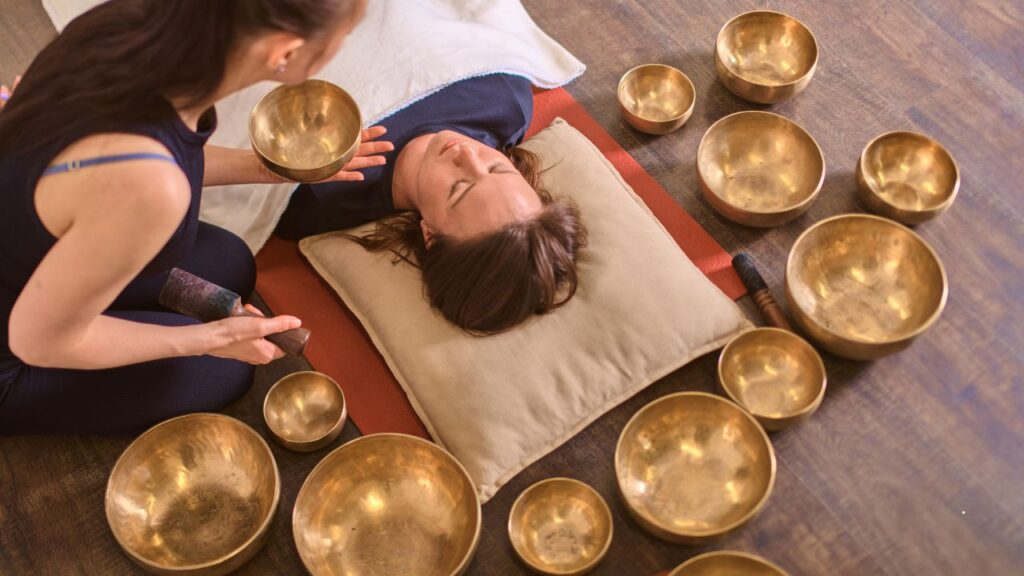
Sound healing is a therapeutic modality that uses acoustic vibration—delivered through instruments such as Tibetan singing bowls, crystal bowls, tuning forks, gongs, and the human voice—to induce measurable physiological and psychological changes in the body. The core mechanism is vibrational entrainment: the body’s natural electromagnetic oscillations synchronise with external acoustic frequencies, producing shifts in brainwave state, autonomic nervous system tone, and cellular activity. A 2020 study published in the Journal of Evidence-Based Integrative Medicine found that a single 60-minute sound bath session reduced tension by 62%, anxiety by 60%, and fatigue by 48% among participants with no prior experience of the modality. The same study recorded a significant decrease in total mood disturbance (TMD) scores, with effects comparable to a standard 45-minute guided mindfulness session.
What Is Brainwave Entrainment and How Does Sound Healing Work?
Brainwave entrainment is the process by which external sensory stimuli cause the brain’s electrical oscillations to synchronise with the frequency of the stimulus. The brain produces five primary oscillation states—gamma (30–100 Hz), beta (13–30 Hz), alpha (8–13 Hz), theta (4–8 Hz), and delta (0.5–4 Hz)—each corresponding to a distinct level of consciousness and physiological state. Sound healing instruments—particularly Tibetan singing bowls (fundamental frequencies: 110–660 Hz) and crystal bowls (fundamental frequencies: 432–528 Hz)—produce complex overtone spectra that drive the brain toward slower, more coherent oscillation states through auditory driving.
| Brainwave State | Frequency Range | Consciousness State | Sound Healing Target |
|---|---|---|---|
| Gamma | 30–100 Hz | Heightened awareness, cognitive processing | Rarely targeted; present in advanced meditators |
| Beta | 13–30 Hz | Active thinking, alertness, anxiety | Starting state for most sound bath participants |
| Alpha | 8–13 Hz | Relaxed alertness, creative flow | First target: reached within 10–15 min of sound immersion |
| Theta | 4–8 Hz | Deep relaxation, hypnagogic state, emotional processing | Primary therapeutic target; deep sound baths (30–60 min) |
| Delta | 0.5–4 Hz | Deep sleep, unconscious processing, cellular repair | Achieved during extended gong baths; Yoga Nidra with sound |
What Are the Main Instruments Used in Sound Healing?
The main instruments used in sound healing are Tibetan singing bowls, crystal singing bowls, gongs, tuning forks, drums, didgeridoos, and the human voice. Each instrument produces a distinct acoustic signature with specific therapeutic applications.
The primary sound healing instruments and their mechanisms are listed below.
- Tibetan Singing Bowls: Hand-hammered from a traditional alloy of 5–7 metals (copper, tin, zinc, iron, gold, silver, lead). Produce fundamental tones between 110 Hz and 660 Hz with rich harmonic overtones. The physical vibration is felt directly in the body when bowls are placed on or near the subject. Used for 2,500+ years in Tibetan Buddhist ritual.
- Crystal Singing Bowls: Made from 99.99% pure quartz crystal ground to specific sizes. Produce clear, sustained tones associated with specific chakras (energy centres) and the 432 Hz and 528 Hz frequencies—the latter documented to repair DNA base pairs in vitro in a 2010 study by Dr. Glen Rein (Journal of the Science of Healing).
- Gongs: Produce broadband frequencies (20–20,000 Hz) that create a wash of sound overwhelming the analytical mind and inducing theta and delta brainwave states within 10–20 minutes. Gong baths are the most potent single-instrument sound healing experience.
- Tuning Forks: Calibrated to specific frequencies such as 128 Hz (used on acupressure points for pain reduction) and 528 Hz (the “Solfeggio frequency” associated with cellular repair). Applied directly to the body or in the biofield (within 15–30 cm of the body).
- Human Voice (Toning and Overtone Chanting): The most accessible sound healing tool. The vagus nerve—a key regulator of the parasympathetic nervous system—runs through the larynx, meaning vocal vibration directly stimulates vagal tone and parasympathetic activation.
What Does the Science Say About Sound Healing?
The science of sound healing is growing rapidly, with measurable physiological outcomes documented in peer-reviewed journals across cardiology, neurology, and oncology. The key findings are summarised below.
| Outcome | Finding | Study |
|---|---|---|
| Anxiety reduction | 60% reduction in self-reported anxiety after single 60-min sound bath | Goldsby et al., JEBIM 2017 |
| Heart rate | Average reduction of 6.5 BPM during Tibetan bowl session | Inácio et al., Complementary Therapies in Medicine 2020 |
| Cortisol | 22% reduction in salivary cortisol after a 20-min tuning fork session | Gaynor, The Healing Power of Sound (clinical data) 1999 |
| Chronic pain | Significant reduction in pain intensity scores after 4 weeks of weekly singing bowl sessions | Rao et al., Cancer Nursing 2016 |
| Post-surgery recovery | Patients receiving live harp music post-operatively required 22% less opioid analgesic | Standley, Journal of Music Therapy 1991 |
What Is a Sound Bath?
A sound bath is a group or individual session in which participants lie in a comfortable supine position (savasana) while a practitioner plays instruments—typically Tibetan bowls, crystal bowls, and gongs—around and above them for 45 to 90 minutes. A sound bath is not a bath of water; the term refers to immersion in overlapping acoustic frequencies. The participant does nothing except receive the sound. Sound baths are contraindicated for individuals with pacemakers, cochlear implants, or first-trimester pregnancy due to the intensity of vibrational exposure at close range.
What Are the Solfeggio Frequencies and Are They Scientifically Valid?
The Solfeggio frequencies are a set of 6 specific tones—174 Hz, 285 Hz, 396 Hz, 417 Hz, 528 Hz, 639 Hz—ascribed to ancient Gregorian chant sequences, referenced by physician Joseph Puleo in 1999 and popularised in New Age sound healing contexts. The scientific validity of Solfeggio frequencies as therapeutic agents is partially supported: 528 Hz has been shown in cellular biology studies to reduce reactive oxygen species (ROS) in brain cells by 80% and to repair DNA in vitro (Ohgami et al., 2018; PeerJ). The broader therapeutic claims for the other Solfeggio frequencies are not yet validated in peer-reviewed clinical trials.
“Sound is the medicine of the future.”
— Edgar Cayce (1877–1945), pioneer of holistic medicine
Experience Healing Practices Through Intentional Travel
Sound healing is most powerfully experienced in a setting designed for deep rest — away from urban noise, digital distraction, and the social performance demands of daily life. À La Carte Travel Concierge creates intentional travel experiences that put you in exactly these conditions.
The Retreat Series: Rest, Reconnect, Restore
The Women to Women Retreat — the first programme in The Retreat Series — is set on 88 acres of Texas Hill Country at Sage Hill Inn & Spa in Kyle, Texas (August 27–30, 2026). The programme creates the acoustic and sensory conditions — natural surroundings, quiet, and intentional community — that make deep healing practices possible. Led by women’s health specialist Rachel Spears, the 4-day programme is limited to 10 women at a total cost of $2,250 per person.
Begin Your Healing Journey
Explore The Retreat Series and register for the Women to Women Retreat, or contact the team to discuss how À La Carte can design a bespoke wellness travel experience for you.