
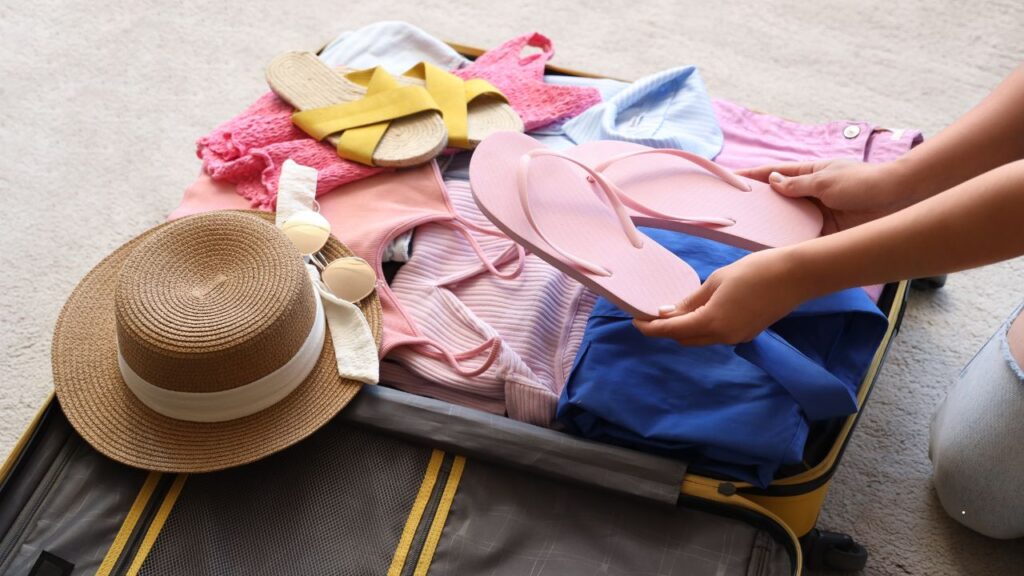
A wellness retreat packing list differs fundamentally from a standard holiday packing list in three ways: it prioritises function over fashion, it includes practice-specific gear, and it deliberately minimises digital and entertainment items that would undermine the retreat’s therapeutic purpose. Overpacking is the most common mistake first-time retreat travellers make—most retreat venues in Bali, India, Costa Rica, and Portugal provide yoga mats, bolsters, blankets, and meditation cushions, meaning you carry less than you think. The most important rule: pack half what you think you need for clothing, and double what you plan for practice layers, sun protection, and documentation.
What Documents Must You Carry to a Wellness Retreat?
The essential travel documents for an international wellness retreat are listed below. Carry originals in your main bag and digital copies accessible from secure cloud storage.
- Passport: Valid for at least 6 months beyond your return date. Most visa-on-arrival countries (including Indonesia/Bali and Costa Rica) enforce this rule at the immigration counter.
- Visa documentation: Indonesia offers a 30-day Visa on Arrival for citizens of 94 countries at $35 USD (as of 2024). India requires an e-Visa applied for a minimum of 4 business days before arrival. Costa Rica allows 90-day visa-free entry for EU, US, UK, Australian, and Canadian passport holders.
- Travel insurance policy document: Carry the printed emergency assistance phone number separately from the policy document. Many policies require a 24-hour emergency call before major medical treatment is authorised.
- Vaccination certificate: Required proof of Yellow Fever vaccination for travellers arriving in some countries from endemic regions. The WHO-approved International Certificate of Vaccination or Prophylaxis (ICVP—the “yellow card”) is the accepted document.
- Retreat confirmation and contact details: Printed copy of your retreat booking confirmation, venue address in the local language (for taxi drivers), and the venue’s WhatsApp number for airport arrival coordination.
What Clothing Is Essential for a Yoga and Meditation Retreat?
Retreat clothing priorities are comfort, breathability, layering capacity, and cultural appropriateness. The following quantities are appropriate for a 7-day retreat and can be extended for longer programmes by using in-venue laundry services (available at most retreat centres for $3–8 USD per load).
| Item | Quantity (7 days) | Notes |
|---|---|---|
| Yoga leggings / practice shorts | 3–4 pairs | Moisture-wicking fabric; avoid pure cotton for yoga (absorbs sweat and becomes heavy) |
| Yoga tops / sports bras | 4–5 | Built-in bra or separate sports bra; at least 2 with shoulder coverage for temple visits |
| Long loose trousers / harem pants | 2 | Essential for Bali temple etiquette and Indian ashram dress codes; lightweight cotton or linen |
| Lightweight long-sleeve layer | 1–2 | For early morning meditation sessions (often held outdoors at 6 AM in Bali; can be cool) |
| Swimwear | 2 sets | One-piece or bikini depending on venue; some Balinese resort pools have modest dress requirements |
| Casual clothes for evenings | 2–3 outfits | Comfortable, packable; avoid heavy jeans in tropical climates |
| Sarong | 1 | Mandatory for Balinese temple entry; doubles as a beach cover-up, travel blanket, and privacy curtain |
| Light rain jacket | 1 | Essential for Bali (Nov–Mar monsoon season) and Costa Rica (May–Nov rain season) |
| Walking shoes / trainers | 1 pair | Closed-toe for nature walks and day trips |
| Flip flops / sandals | 1 pair | Slip-on; most retreat venues are shoe-free indoors |
What Practice Equipment Should You Bring to a Retreat?
Most established retreat venues provide yoga mats, blocks, bolsters, straps, and meditation cushions. The practice items worth carrying from home are personal hygiene items and tools that benefit from familiar contact or specific specification.
The recommended personal practice items to bring are listed below.
- Personal yoga mat (optional): A lightweight travel mat (1–3mm thickness, under 1kg; brands: Lululemon Take Form Travel, Manduka eKO Superlite) is worth bringing if you have strong mat hygiene preferences. However, venue mats are uniformly provided.
- Meditation shawl / blanket: A lightweight wool or cashmere shawl (100–200g) wraps around the shoulders during morning meditations and seated practices in air-conditioned spaces.
- Journal and pens: Journalling is a core practice component at most retreat programmes. A dedicated hardcover journal (A5 size is practical) separate from everyday notebooks creates a defined retreat record.
- Mala beads (optional): A traditional 108-bead mala for mantra practice; relevant primarily for meditation-focused programmes with mantra components.
- Ear plugs: For light sleepers at open-air Balinese retreat venues where roosters and ceremony sounds begin at 5:30 AM.
What Wellness and Health Items Are Essential?
The essential health and wellness items for an international retreat trip are listed below.
- Prescription medications: A full supply for the entire trip plus 7 additional days as buffer, in original labelled containers. Carry a letter from your prescribing physician in English.
- Probiotics: Begin taking a high-potency probiotic (at least 10 billion CFU; strains Lactobacillus acidophilus and Bifidobacterium longum) 2 weeks before departure to reduce traveller’s diarrhea risk, which affects 20–50% of international travellers.
- Electrolyte sachets: Essential for tropical retreats. Heat + yoga sessions deplete sodium and magnesium rapidly; electrolyte sachets (Nuun, Liquid IV, or equivalent) prevent hyponatraemia in active retreat participants.
- Sunscreen SPF 50+: Reef-safe mineral sunscreen (zinc oxide-based) is required for Costa Rica (legally mandated in Manuel Antonio National Park) and strongly recommended for Bali.
- Insect repellent: 20–30% DEET-based for dengue fever prevention in tropical destinations. Apply to exposed skin and the cuffs of clothing during dawn and dusk hours when Aedes mosquitoes (dengue vectors) are most active.
- First aid basics: Adhesive bandages, antiseptic wipes, blister plasters, antihistamine cream, and oral rehydration salts.
What Technology Should and Should Not Come on a Retreat?
Technology packing for a retreat requires deliberate minimalism. Most retreat programmes enforce or strongly encourage a no-device policy during programme hours, making the majority of standard travel technology unnecessary or counterproductive.
| Item | Decision | Reason |
|---|---|---|
| Smartphone | Bring (but use only outside programme hours) | Emergency contact, navigation, translation apps |
| Laptop | Leave behind (unless work-essential) | Work access undermines digital detox; defeats retreat purpose |
| Tablet | Leave behind | Redundant with phone; entertainment device incompatible with retreat intent |
| E-reader (Kindle etc.) | Bring | No social media, no notifications; excellent for early mornings and rest hours |
| Noise-cancelling headphones | Bring (for travel only) | Invaluable on flights; leave in room during retreat hours |
| Universal power adaptor | Bring (essential) | Indonesia uses Type C/F (220V); India uses Type C/D/M; Costa Rica uses Type A/B (110V) |
| Portable power bank | Bring | 10,000 mAh minimum for day trips away from the venue |
What Are the Destination-Specific Packing Additions?
Each wellness retreat destination requires specific additions to the standard packing list based on climate, culture, and activity profile.
- Bali, Indonesia: Add a sarong (mandatory for temple entry), reef-safe sunscreen, mosquito-repellent clothing, and a light waterproof jacket for the Nov–Mar monsoon season. Water purification tablets or a SteriPen are recommended for rural retreat locations.
- India (Rishikesh / Kerala): Add a dupatta or shawl for ashram dress codes, conservative (non-transparent) loose clothing for public areas, a high-quality water filter bottle, and your own yoga mat (shared mats at some ashrams are not consistently sanitised).
- Costa Rica: Add reef-safe sunscreen (legally required at several national parks), waterproof walking shoes for jungle hikes, and a dry bag for beach and rafting activities. Costa Rica’s water is potable from the tap in most urban areas but not all rural retreat locations.
- Portugal: Add a light wool layer for evenings (coastal locations can be cool year-round), comfortable walking shoes for cobblestone streets, and an EU travel adaptor (Type F/C). Portugal’s tap water is safe to drink throughout the country.
Plan Your Retreat Journey With À La Carte Travel Concierge
Packing correctly is one part of retreat preparation. The most important preparation is choosing a programme where every logistical detail has been thought through for you. À La Carte Travel Concierge — a San Antonio-based luxury travel concierge agency with over 60 years of combined expertise — handles every detail of your retreat journey from planning to arrival.
The Retreat Series: Everything Included, Nothing to Figure Out
The Women to Women Retreat — the first programme in The Retreat Series — takes place at Sage Hill Inn & Spa in Kyle, Texas (August 27–30, 2026). The programme fee of $2,250 per person covers 3 nights’ luxury accommodation, daily breakfast, a welcome dinner, morning meditation, guided hiking, women’s health coaching with Rachel Spears, and a 30-minute massage. Participants need to arrange their own transport to Sage Hill — approximately 35 minutes from Austin-Bergstrom Airport or 55 minutes from San Antonio International Airport. Everything else is handled.
Reserve Your Place or Start a Conversation
View full programme inclusions and register for the Women to Women Retreat. For custom retreat journey planning — packing guidance, health preparation, and full logistics — contact the team directly or schedule a free 30-minute consultation.