
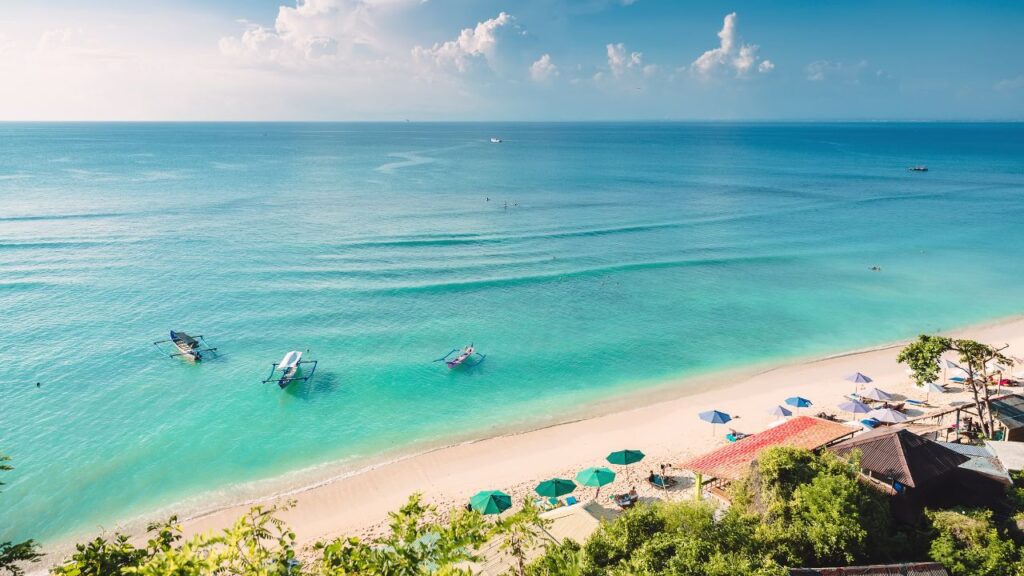
Bali has a tropical monsoon climate classified as Aw (tropical wet and dry) on the Köppen Climate Classification—meaning two distinct seasons: a dry season from April to October and a wet season from November to March. Average daily temperatures remain consistent year-round between 27°C and 32°C (80–90°F) at sea level, with humidity ranging from 70% in the dry season to 85–90% during peak monsoon months. Altitude significantly moderates the climate: Ubud (475m above sea level) averages 4–5°C cooler than coastal areas, and the highland retreat district of Munduk (1,000–1,200m) can drop to 17–20°C at night—making it the preferred location for practitioners who find tropical heat challenging. The best months for a wellness retreat in Bali are May, June, September, and October—optimal for comfort, crowd levels, and pricing.
What Is the Month-by-Month Climate Guide for Bali?
| Month | Season | Avg Temp (°C) | Rainfall (mm) | Crowd Level | Retreat Suitability |
|---|---|---|---|---|---|
| January | Wet | 27–30 | 307 | Low | Good – Lush, quiet, best prices; afternoon rain is common but brief |
| February | Wet (peak) | 27–30 | 337 | Very Low | Fair – Highest rainfall; outdoor sessions may be disrupted; best yoga studio focus |
| March | Wet → Transition | 27–31 | 210 | Low | Good – Rain easing; Nyepi (Balinese New Year) creates a 24-hour island-wide silence day |
| April | Dry (start) | 28–32 | 90 | Moderate | Very Good – Ideal temperatures; green landscape from wet season; competitive pricing |
| May | Dry | 28–32 | 88 | Moderate | Excellent – Optimal conditions; school term period; manageable crowd levels |
| June | Dry | 27–31 | 54 | Moderate–High | Excellent – Low humidity; ideal for outdoor practice; slight school holiday increase |
| July | Dry (peak) | 26–30 | 43 | High (peak) | Good – Best weather; highest prices; busiest retreat season |
| August | Dry (peak) | 26–30 | 33 | Very High (peak) | Good – Perfect weather; peak tourist season; early booking essential (6+ months) |
| September | Dry | 27–31 | 60 | Moderate | Excellent – School term; ideal weather; retreat availability improves significantly |
| October | Dry → Transition | 27–32 | 95 | Low–Moderate | Excellent – Warm, mostly dry; best value month in dry season; shoulder season pricing |
| November | Wet (start) | 27–31 | 178 | Low | Good – Short rains; quiet; lush greenery; good for practitioners who tolerate humidity |
| December | Wet | 27–30 | 256 | Moderate–High | Fair – Holiday crowds + increasing rain; Christmas and New Year premium pricing |
What Is the Climate Like in Bali’s Main Retreat Districts?
Bali’s three primary retreat districts—Ubud, Canggu, and Seminyak/Kuta—each have a distinct microclimate and cultural environment that affects the retreat experience.
The climate and character of each retreat district are described below.
- Ubud (475m above sea level): The spiritual and cultural heart of Bali, averaging 4–5°C cooler than coastal areas. Ubud receives higher annual rainfall (1,956mm/year) than the coast, but its altitude and forested surroundings make it the most comfortable location for active yoga practice year-round. Ubud houses the highest concentration of yoga schools, healing practitioners, and meditation centres on the island.
- Canggu (sea level, 8km north of Kuta): A coastal surf and wellness community with a vibrant international population. Temperatures are higher than Ubud (28–33°C), humidity is elevated, but ocean breezes moderate the heat. Canggu is the preferred location for yoga + surf retreat combinations and digital nomad wellness programmes.
- Seminyak / Kuta (sea level): The most developed tourist area; hotel and resort density is highest here. Retreat centres exist but the environment is less conducive to deep immersion than Ubud or Canggu due to noise, traffic, and commercial density.
- Munduk / North Bali (1,000–1,200m): Bali’s coolest retreat district; temperatures range from 17–25°C year-round. Specialist ayurvedic, meditation, and healing retreat centres operate here in near-complete silence, surrounded by coffee plantations and volcanic crater lakes.
What Are Bali’s Major Cultural Events and How Do They Affect Retreat Planning?
Bali’s Hindu cultural calendar—distinct from the national Indonesian calendar—contains dozens of annual ceremonies, three of which significantly affect retreat and travel planning.
| Event | Timing | Impact on Visitors | Recommendation |
|---|---|---|---|
| Nyepi (Balinese New Year / Day of Silence) | March (date varies by Saka calendar) | Complete island shutdown for 24 hours: no travel, no noise, no lights, no leaving accommodation | Experience from within your retreat venue; uniquely powerful for meditation practitioners |
| Galungan and Kuningan | 10-day festival every 210 days (Pawukon cycle) | Intense ceremony activity; streets lined with penjor (bamboo decorations); some services reduced | Exceptional cultural immersion opportunity; plan activities around temple ceremony schedules |
| Ogoh-Ogoh Parade (eve of Nyepi) | Night before Nyepi | Spectacular street processions of giant demonic effigies; very loud, very festive | Watch from a safe distance; not compatible with the retreat silence intention on the following day |
What Cultural Etiquette Rules Apply to Retreat Visitors in Bali?
Bali is a deeply Hindu society—the only Hindu-majority region in the world’s largest Muslim country—and its sacred spaces require specific etiquette from all visitors.
The essential cultural etiquette rules for retreat visitors in Bali are listed below.
- Temple dress code: A sarong and sash (selendang) are mandatory for entering any Balinese temple (pura). Both items are provided free of charge or for a small donation at temple entrances.
- Menstruation restriction: Women who are menstruating are traditionally asked not to enter the inner temple sanctuary (jeroan). This rule is signposted at major temples and is a sincere religious request.
- Canang sari offerings: Small palm-leaf offerings placed on the ground, steps, and roadside by Balinese Hindus are sacred objects. Do not step on them or photograph them close-up without permission.
- Left hand: Avoid using the left hand to give or receive objects, money, or food. In Balinese (and broader Indonesian) culture, the left hand is considered unclean.
- Pointing: Do not point at people or sacred objects with your index finger; use your thumb or an open hand instead.
- Physical affection: Public displays of physical affection (kissing, embracing) are inappropriate in Balinese villages and at traditional ceremonies. Beach and resort areas are more permissive.
What Is the Currency, Language, and Connectivity Situation in Bali?
The Indonesian Rupiah (IDR) is the sole legal tender in Bali. As of early 2024, 1 USD = approximately 15,700 IDR; 1 EUR = approximately 17,200 IDR. ATMs are widely available in Ubud and Canggu; rural retreat locations may require cash to be drawn in advance. The official language is Bahasa Indonesia, but English is widely spoken in Ubud, Canggu, Seminyak, and at all established retreat venues. Mobile data coverage via local SIM cards (Telkomsel or XL Axiata) is excellent in all developed areas but limited in Munduk and highland regions. A 20GB local SIM costs approximately 70,000–100,000 IDR ($4.50–$6.50 USD).
Plan Your Wellness Travel With À La Carte Travel Concierge
Bali is one of the world’s great wellness travel destinations — and visiting it well requires local knowledge, vetted partners, and careful planning. À La Carte Travel Concierge is a San Antonio-based luxury travel concierge agency with over 60 years of combined expertise designing bespoke journeys. Ana and Stephanie have the destination knowledge and global partner network to design a Bali travel experience built around your specific goals.
Start Closer to Home: The Retreat Series
Before planning an international wellness journey, many travellers benefit from experiencing what a structured retreat can deliver in a domestic setting. The Women to Women Retreat — the first programme in The Retreat Series — offers exactly this: 4 intentional days at Sage Hill Inn & Spa in Texas Hill Country (August 27–30, 2026), led by women’s health specialist Rachel Spears, with morning meditation, guided hiking, coaching, and a 30-minute massage included. Total cost: $2,250 per person. Limited to 10 participants.
Plan Your Wellness Journey
View The Retreat Series for our current live retreat programme, or contact Ana and Stephanie to start planning your Bali wellness journey with a team who knows the destination.